
The Story Behind Air Codes: How Wind, Freedom and Renewal Shaped the Next Chapter of Elemental Codes
Updated: Oct 5

How Air Codes by Tabytha Polaris Began
Water Codes seemed to pour out of me.
I wrote most of the lyrics and melody in about ten minutes.
Air Codes was different.
By the time I began writing it, the concept for Elemental Codes had already been established. I knew I was creating a four-song journey through Water, Air, Fire and Earth, and Air was the next place I needed to go.
But instead of waiting for another song to simply arrive, I had to intentionally step into the creative process.
And one of the most important things I did was give myself permission to write freely.
Giving Myself Permission to Create
As I was growing in confidence as a songwriter, I realized how easily self-criticism could interrupt creativity.
So before writing Air Codes, I made a conscious decision.
I was going to write this song for me.
I wasn't going to worry about what anyone else might think. I wasn't going to judge every lyric while I was writing it or question whether an idea was good enough.
I wanted to move my analytical mind out of the way and allow myself to create from the heart.
That permission changed the way I approached the song.
I wanted Air Codes to feel magical, unusual, light, upbeat and free.
Water had carried the emotional weight of release and healing.
Air was going to move.
Researching the Element of Air
I began by researching and brainstorming everything I could about air.
I wasn't trying to write finished lyrics yet. I simply wanted to surround myself with ideas and see what inspired me.
I filled pages with words and associations—breath, wind, movement, freedom, communication, life-force energy, consciousness, clouds, seasons and the feeling of rising.
I wrote about what air could represent spiritually and emotionally, but I also thought about the physical experiences I had loved my entire life: wind against my skin, trees moving during a storm, changing weather and the feeling of being outside when the atmosphere suddenly becomes alive.
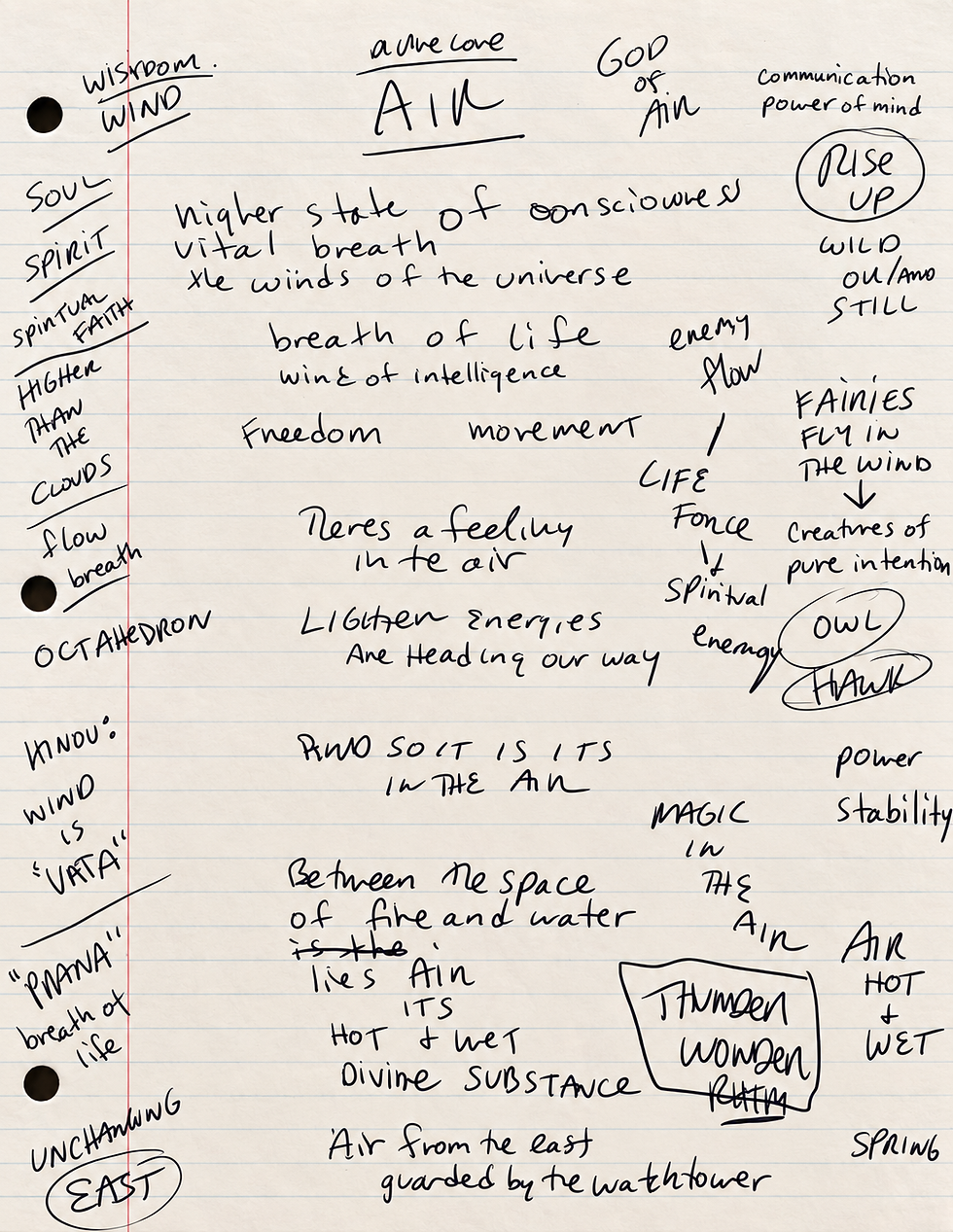
During that research, I came across the idea of air existing between fire and water.
That image immediately stayed with me and eventually became part of the second verse:
“Between the space of fire and waterLives the air, hot and wetShe flies between the clouds above the earthShe is my life, she is my breath.”
I also came across references to Vata in connection with wind and prana as breath or life-force energy.
Those ideas connected naturally with what I was already trying to express.
Air wasn't empty.
Air was life.
Air was movement.
Air was breath.
Meeting the Goddess of Air
As I kept free-writing, the element began becoming a character in my imagination.
I saw a powerful, enchanting feminine figure—almost like a fairy queen or goddess—standing in the east on top of a mountain cliff overlooking the ocean.
I had seen landscapes on Long Island, especially around Sands Point Preserve, that carried a similar feeling for me, and that kind of scenery began mixing with the fantasy world forming in my imagination.
She wasn't simply standing in the wind.
She was part of it.
She could move with it, direct it and carry its energy.
That image inspired the opening verse:
“I hear the whisper of the goddess
Who shares her songs in the wind
I feel the magic floating through the air
As she watches in awe over the ocean.”
Suddenly the song wasn't only about an element.
There was a world forming around it.
What Air Feels Like to Me
For the chorus, I stopped researching and came back to something much more personal:
What does air actually feel like to me?
“I feel the air brushing on my skin.”
That became the beginning.
Then I started thinking about the strange power of air.
Wind can move water.
It can help spread a wildfire, yet a gentle breath can also extinguish the flame of a candle.
That contrast fascinated me.
So this beautiful, ethereal air goddess could appear gentle while still possessing enormous power.
That inspired:
“She moves the water, kills the flame.”
And then I brought the song back to my own healing journey:
“I breathe it in till I hurt no more.”
Followed by:
“She is the air, she heals my pain.”
The call-and-response structure of the chorus began growing naturally from those ideas.

From Healing to Renewal
Air Codes represented a very different place in my life than Water Codes.
Water had been about cleansing.
Release.
Allowing pain and negativity to wash away.
By the time I was writing Air, I felt like I was moving forward.
I was becoming stronger.
More confident.
More hopeful.
I felt refreshed.
To me, air brings energy back into the body. You breathe it in. You feel the wind. You feel movement around you.
It can wake you up.
So Air Codes became a song about renewal, strength, breath and freedom.
Water helped me release.
Air helped me recharge.
Seeds, Trees and Life-Force Energy
My relationship with nature continued finding its way into the lyrics.
I love gardening, and I've watched the wind carry seeds from plants across my yard.
That became:
“She scatters seeds far across the land.”
I've also always loved storms and powerful wind.
Watching trees move and feeling the atmosphere change can make me feel energized—as though nature itself is charging the air around me.
That feeling inspired another image in the song:
“I see the trees blowing beside her,
Enchanting life force energy.”
The air goddess was becoming a representation of everything I felt when I experienced wind: movement, life, magic, power and freedom.
Creating Contrast With the Pre-Chorus
I didn't want every section of the song to have the same energy.
The chorus was becoming upbeat and rhythmic, so I wanted the pre-chorus to reveal the gentler side of air.
That's where I began layering the softer vocal sounds:
“She's singing Oh, Oh, Oh
The light she's bringing Oh, Oh, Oh
Listen close, listen close.”
This was also where I began speaking more directly to the listener.
The song wasn't only describing the goddess anymore.
It was becoming an invitation.
Listen.
Feel it.
Notice what's around you.

Discovering the Melody With the RAV Vast
Once I had developed the lyrics and concepts, I used my RAV Vast drum to help discover the melody.
But I didn't compose an instrumental melody on the drum and then sing along with it.
I intentionally played mostly individual notes.
I wanted enough musical information to give my voice somewhere to begin, but not so much that I restricted myself.
Then I improvised vocally over those notes.
That gave me the freedom to discover where the melody naturally wanted to go.
By the time I went into Cove City Sound Studios, I had the verses, chorus, pre-chorus, melody and overall concept of the song.
But Air Codes wasn't finished yet.
Learning to Let Someone Into the Songwriting Process
Before those recording sessions, I had actually been researching something else:
How do other artists write songs?
I was fascinated by how different the process could be.
Some artists don't write their own songs at all.
Some work with teams of songwriters.
Some enter the studio with only an idea.
Others arrive with detailed demos and then work with a producer to develop the track further.
I also wanted to understand what a music producer actually did.
What surprised me was how involved producers could be in shaping a song, even when an artist had already done a great deal of writing beforehand.
That made me think about the kind of artist I wanted to be.
Songwriting feels very sacred to me.
My songs feel almost like my children.
Allowing someone else into that creative space was a big decision.
But during Air Codes, I decided I wanted to remain open to collaboration when collaboration genuinely made the music better.
And that became an important philosophy for me:
If someone contributed a bass line, drum beat, guitar riff, melody, lyric or creative idea that became an integral part of one of my songs, I wanted to acknowledge their contribution.
The magic of creating music didn't have to belong to only one person.

Finishing Air Codes With Brendan Keenan
That philosophy became real during my session with producer Brendan Keenan.
Brendan listened to what I had written and felt the song needed one additional section—a bridge.
He began playing chords on the keyboard.
I started singing over them.
We followed what was happening in the room and collaborated on the lyrics and melody until the bridge became:
“Dancing on the wind
Not far from the stars
Feel the light within
All this love is ours
Beauty when she moves
Floating through the sky
Feel the love within.”
That was the first time Brendan and I had collaborated in that way on the songwriting itself.
And by the end of that session, the song was complete.
Building the Sound of Air
Once the structure was finished, we began building the production.
I played Brendan the RAV Vast part and sang through the song.
The little resonant sounds of the RAV Vast that you hear in the finished recording trace directly back to the way I had originally worked on the song at home.
Then we developed the rhythm.
I wanted Air Codes to be more uptempo than Water Codes—something with movement.
I loved when the beat finally came together.
Brendan added his own beatbox vocals, which gave the rhythm such a unique character.
I added hand claps.
Brendan added Wurlitzer and synth.
I had ideas for harp-like accents and other magical textures.
And then I brought in the kalimba.
I've always thought the kalimba sounds magical and light—almost fairy-like—so it felt completely at home inside the world of Air Codes.
Later, when my friend David Connolly was in the studio recording parts for Earth Codes, we played Air Codes for him and he added electric guitar riffs toward the end of the track.
The finished recording became a mixture of organic instruments, electronic textures, unusual sounds and layered voices.
Exactly the kind of world I wanted to create.

Using My Voice as an Instrument
Once much of the production was in place, I recorded my final lead vocal and began creating the vocal arrangement.
This is one of my favorite parts of making music.
I normally record the main melody first and then begin inventing harmonies around it directly in the studio.
I usually don't write those harmony parts down beforehand.
I hear them.
I sing them.
And often I can build the entire arrangement within only a few takes.
I've been singing harmonies since I was young—first in choir beginning around fourth grade and later through years of bands and other musical projects.
That experience has become part of how I instinctively hear music.
I truly think singing harmonies and designing vocal arrangements is one of my musical superpowers.
I loved recording all of the “oohs” and layered parts in Air Codes and letting my voice become another instrument inside the production.
And I knew I wanted the ending to be more powerful.
So on the final chorus, I belted the melody an octave higher and layered that voice over the chorus in its regular octave.
I wanted the song to finish with a bang.
The Music Video That Already Exists in My Head
The visual world of Air Codes began forming before the recording was even finished.
Once I imagined the fairy-like Air Goddess standing on the mountain overlooking the ocean, I could see the video.
I was also taking ballroom-dancing lessons at the time.
Because the song had such a fun beat, I began imagining myself dancing in the video—sometimes with a king or partner and sometimes with a group of friends.
Movement belonged in this world.
Wind moves.
Fabric moves.
Hair moves.
Trees move.
Bodies move.
The entire visual concept began growing around that idea.
And the strange thing is that the video still exists completely in my head.
The locations.
The costumes.
The makeup.
The choreography.
The characters.
The shots.
The transitions.
The entire storyboard.
I simply haven't had the budget yet to produce everything I see.
When a Song Starts Becoming a World
That's one of the things that fascinates me most when I listen to Air Codes today.
I don't hear only a song.
I see a place.
I see the goddess.
I see the mountain.
I see the ocean.
I see movement and dancing and wind.
And now that I'm developing my fantasy series Tabytha Polaris Of Ocram, I can imagine something else:
An entire adventure built around searching for this mysterious Queen of Air.
Maybe some of those images that began as a music video years ago were actually pieces of a much larger world waiting for me to understand what they were.
What Air Codes Means to Me Now
When I listen to Air Codes today, I'm grateful that we recorded it exactly the way we did.
For me, it feels complete.
The unusual sounds, the rhythm, Brendan's beatboxing, the kalimba, David's guitar, the RAV Vast, the vocal layers and that final octave all belong together.
More importantly, the song preserves a particular moment in my life.
I was learning to trust myself creatively.
I was learning to stop censoring ideas before they had the opportunity to become something.
I was learning to collaborate.
And I was continuing to move forward in my own healing.
Water Codes had helped me release.
Air Codes reminded me to breathe again.
To move.
To create.
To feel energized.
To rise.
And maybe that's what the element of Air still represents to me most:
Freedom.

ELEMENTAL CODES EP
Released in 2022, Elemental Codes is a four-song concept EP exploring Water, Air, Fire and Earth through personal experiences, dreams, nature and symbolism. Each element shapes its own musical and visual world, blending ethereal layered vocals with organic and electronic instrumentation.


Comments